



Introduction: Do you really need a strategy?
Yes. PR is a full-time job, and the day-to-day tasks are so time-consuming that teams often start missing the big picture, and instead end up focusing on tasks that might not have an impact on their core objectives. Public relations strategic planning should have a positive impact on your brand, and the best way to ensure this is to have a strategy in place, and a plan to execute it.
Your PR plan and strategy will help you navigate and prioritize every day’s demand. With established goals, you can follow the best tactics to create an impact. While every brand is different, we’ll go through the fundamental parts you need to be able to develop a strategy and plan around it using our PR tools and strategies.


1. Assess the situation
Whether you call it an analysis or an assessment, this is the foundation of any future decisions you make. This is where PR teams and public relations strategic planning can – and should – work with stakeholders like marketing, product, commercial, and customer support to get a complete overview of the business situation and the markets or environments in which you operate. Your financial situation, business goals, corporate image, product plans, and competitors are just some examples of information you should have in your situation analysis that will inform your PR strategy and goals.
Also, keep an eye on the big picture. Consider these questions when doing public relations strategic planning:
- What does your industry look like today?
- Have there been any significant changes in the last few years?
- What might change in the coming period?
- Which economic and political conditions might affect your industry?
- How is AI changing how your audiences discover and consume information about your brand - and are your owned channels structured to take advantage of that?

2. Identify your audiences
Sending your message out to the world at large is not an effective approach. Identifying who you’re talking to – and gaining an understanding of them – is the crucial foundation of effective PR. Taking the time to research and connect with your audience using PR tools and Strategies will help you develop your entire approach, adding a focus and intent to your strategy that will speak clearly through your end results.
Your public relations strategic planning should keep in mind two groups of audiences – your buyers, and people who can influence your buyers.
Your main target audience
When developing your strategy, keep your customers front-of-mind as your main target audience. Take the time to get to know them; the customers themselves will provide the most important information for setting your PR strategy:
- Find out who your buyers are and why they pay for your product/s or use your services.
- Define and craft the story that speaks to their needs.
- Research where and how they consume media.
Those who can influence your main target audience
This group can include journalists, bloggers, influencers, and editors of publications in your industry. Industry experts and thought leaders with a large following also belong here. Your Presspage media database gives you access to around 900,000 media contacts - including journalists, bloggers, and influencers - to help you identify and reach the right people.
AI systems
AI platforms - including ChatGPT, Perplexity, and Google's AI Overviews - have become a third, increasingly influential audience for PR teams. When someone asks an AI system a question about your industry, your competitors, or your brand directly, the answer it generates is shaped by whatever content is publicly available and well-structured enough to interpret.
This means the content on your owned channels - your newsroom, press releases, and blog - needs to be written and structured not just for human readers, but for machines too. Clear definitions, direct answers, and regularly updated information all improve the chances of your brand being understood and cited correctly.
|
ActionDo background research on where your competitors are mentioned - in publications, on social media, and in AI-generated answers - to help you identify both the outlets to reach out to and the owned content gaps you need to fill. |

You can reach your first group of audiences much better by developing better relationships with the second. You should also have an easy process set up for this group to get relevant and valuable information from you - such as establishing a well-structured newsroom that makes it easy for journalists to find your content, and for AI systems to interpret and cite it correctly.

3. Set up PR goals and objectives
Public relations strategic planning goals and objectives are sometimes used interchangeably, leading to plenty of confusion. In this guide, we’ll discuss the G.O.S.T model – Goals, Objectives, Strategies, and Tactics.
Goals
What you want to accomplish overall.
Ex.: [Your brand] wants to become the best-known brand for [your product/sector] in the US.
Objectives
The specific outcomes from your public relations strategic planning should define how you achieve the goal. These should be SMART (specific, measurable, agreed upon, realistic and time-based).
Ex. Increase the number of new visitors to the website by 20% in 2020.
Strategies
The approach you take to achieving measurable objectives.
Ex. Implement an ambassador program.
Tactics
PR Tools and Strategies you use to support the tactics that you’ve decided on.
Ex. Reach out to 50 US-based influencers and bloggers with personalized pitches.
Companies have taken different approaches to applying the G.O.S.T model in PR teams. The first is by having “Goals” as the overall business or company goals, with PR objectives or strategies coming in below to support the goal.
Business GoalWe want our company to be the number 1 selling brand in this industry Business ObjectiveIncrease sales by 15% this year PR Strategies To Support Business ObjectivesIncrease traffic to our e-commerce website by collaborating with influencers and have them promote our product |
The second is by setting up a complete G.O.S.T model within the PR/communications team that’s based on overall company goals or objectives.
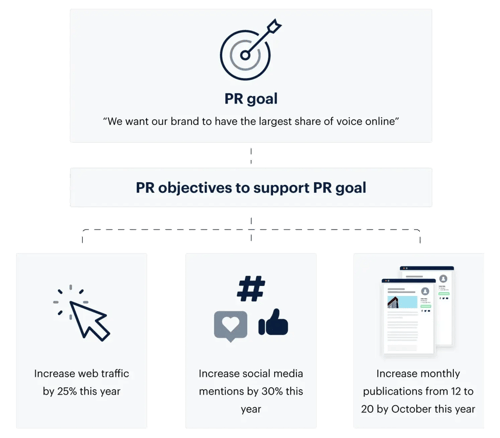
A third approach applies when AI visibility is a strategic priority for your team:
Business GoalWe want our brand to be the most visible and credible source in our industry Business ObjectiveIncrease AI Citation Share by establishing our newsroom as a primary reference source for industry topics by end of 2026 PR Strategies To Support Business ObjectivesPublish structured, authoritative content on owned channels optimized for both search and AI discovery |
Setting up a model like G.O.S.T is a crucial step to give your team direction when juggling multiple tasks. It might be difficult to see the impact of one press release after another, but having concrete numbers will give you a clear objective to strive for. With every public relations strategic planning activity, you can set goals such as increasing website traffic, blog subscriptions and share of voice on social media. Digital tools are crucial in helping you measure impact.

4. Develop key messages
Key messages are the essence of what you want to communicate with your customers and will be the building blocks for all your tactics and activities developed through the help of your PR tools and strategies.
Think of key messages as the anchor that keeps all your communication unified and consistent, and what will inform all the messaging on your other PR channels. Here are the three things to consider when crafting key messages:
- Revisit your company’s mission and core values.
- Pick words and phrases in your brand vocabulary, avoid anything too generic or too similar to your competitors’ key messages.
- Consider the assessment of your situation to address changes in the industry and any new identity that your brand wants to adopt.
Your key messages should be concise, simple, and adaptable.
Concise: Lengthy messages are difficult to remember and adapt.
Simple: It should be easy to understand for most people. No jargon or acronyms.
Memorable: In this world of information overloading, easy-to-recall messages stand out.
Adaptable: for being used in different channels and various forms. Avoid using wordplay that only sounds smart, for example, in writing but not when speaking.
Compelling: You want your audiences to take action.
Evocative: The best messages are the ones that evoke strong feelings and the desire to be a part of something bigger than themselves.
Well-crafted key messages are also more likely to be extracted and cited by AI systems. Clarity and specificity matter beyond human recall, as a message that is direct, standalone, and jargon-free is easier for both people and machines to understand and repeat accurately.
Let’s go over a quick example of a key message and its supporting messages.
“Our company’s products deliver tangible ROI” |
While this is the core message we want to communicate, we wouldn’t use this particular wording in our external communication. Instead, we would create PR tools and strategies where we can drive secondary messages forward that support this key message. Supporting messages would look something like this:
“Our customers on average report an increase in revenue of 29% after 6 months of using our product” |
Your PR team could complete public relations strategic planning out of these supporting messages, for example in writing articles about specific customers that have benefited from the product. Further proof points like hard-hitting quotes can be used to strengthen the message. Example:
“Since we started using this product, referral traffic from the newsroom to our e-commerce website has increased by over 180%” |
5. Identify PR channels
Now it’s time to decide on how you’re going to deliver your messages to your target audiences. There are various PR tools and strategies that PR pros can use to approach their customers. It’s important to recognize that you don’t have to do it all, especially if your team is fairly small. Identify channels where your target audiences spend their time, and what tactics will get you the most value. Common PR channels that should be included in your public relations strategic planning are:
- A central newsroom or media center
- Press releases
- Blogs
- Social media
- Events
Newsroom
Whether you call it a brand newsroom, media center, or press page, the premise is the same: a communications hub that connects the organization with its audiences. Newsrooms tend to be at the core of a PR team's content publication strategy, the place where your brand's news and stories live in a form that journalists can work with and stakeholders can trust.
But in 2026, your newsroom is also an AI visibility channel. When AI systems generate answers about your industry or your brand, they draw from whatever is publicly available and well-structured enough to interpret. A newsroom that is regularly updated, clearly organized, and written in plain declarative language gives AI systems a reliable source to pull from and reduces the risk of your brand being misrepresented by less accurate sources elsewhere.
To get the most from your newsroom, set clear goals and objectives for it, maintain a content calendar, and measure its performance as you would any other channel.

Read more in our ultimate guide to managing a brand newsroom
Everything you need to build and manage a successful brand newsroom.
Press releases
PR professionals have always been creating and distributing press releases to get the word out. Although many have declared the death of the press release, it can still have a significant impact if done right. Here are some action points to make it an effective channel in today’s digital landscape:
Offer value
Only share releases that are truly newsworthy. Avoid self-promoting as it doesn’t sit well with today’s savvy, value-seeking customers.
Make it SEO and GEO friendly
Publishing press releases on your owned newsroom should be the priority. This is where journalists and AI systems will look for the authoritative version of your news. Structure your releases clearly: a direct headline, a strong opening paragraph, and plain factual language all help both search engines and AI systems understand and surface your content correctly. For additional distribution reach, platforms like PRWeb, Connectively, or Qwoted can help you get in front of journalists actively looking for sources and stories.
Track open and click rates
Data such as open and click rates can give you an indication of how your contact list feels about the content you’re sending them. Presspage helps you build an online newsroom at ease. You can also take advantage of our database of influencers and media contacts.

Brand journalism and blogging
Well-crafted, high-quality articles can contain useful information for a specific audience with a particular problem, earning the trust of your readers and attracting the attention of mainstream media. If you have the expertise to create an in-depth guide or a valuable resource, publish it on your owned channels first. Content that is authoritative, well-structured, and regularly updated is more likely to earn links from other publications, get picked up by journalists, and be cited by AI systems when generating answers about your industry.
Social media
Social media accounts are becoming the first touchpoint that a brand might have with many customers. You can further your interaction with followers and amplify your other content like blog posts or press releases. Many companies even have dedicated social media accounts just to engage with journalists and post news that’s why you should include this in your public relations strategic planning.

Ultimate Guide to PR Distribution
Get coverage for your stories and reach the right audiences.

6. Plan the Budget
Planning a budget is central to ensuring you have the resources, PR tools, and strategies to achieve your goals. Take into consideration the cost of both earned media and branded (paid) content. PR teams commonly allocate budgets for tools, (paid) channels, events, and agencies. Agencies can be in the form of PR agencies who support the writing, pitching, and publication process, or design agencies who work with in-house PR teams to create content. Examples of the type of tools that support your PR team include those that cover publication, measurement, distribution, project management, and automation.

7. Measure the results
Brand awareness is not the easiest thing to measure, and PR pros often find it challenging to demonstrate ROI in their activities that’s why you need Presspage’s PR distribution software.
Here are some examples of how you can plan to measure the impact of your activities using PR tools and strategies so that you can see what’s working and what you can improve.
Website traffic (organic and referral)
You can measure the percentage of total web traffic you are driving with PR activities. Using GA4, you can add UTM tracking codes to all PR campaigns for a detailed picture of how each one performs. In addition to the number of visits, you should measure:
- Time spent on the site and each page
- The number of pages each visitor consumes
- The bounce rate
Tools like GA4 and Presspage can give you insights into the traffic on your newsroom and individual press releases.
Search Engine Optimization (SEO)
When your audience searches for a product or service you provide, or even if they’re searching for topics online related to your industry, you want to appear on the front page of those search results. PR tools and strategies are incredibly effective at boosting PR SEO, and SEO is a great tactic to help increase brand awareness. Two elements of SEO that you should get familiar with:
Domain Strength
How likely your website is to perform in search is partly determined by the quality and quantity of sites linking back to it. High-quality content that is regularly updated plays a significant role in attracting those links and improving your overall search performance.
Backlinks
A backlink is a link on another website that directs readers back to your site. When you earn backlinks from publications with high readership or blogs of industry influencers, it signals credibility to search engines and can improve your ranking. Focus on the quality of referring domains over raw backlink count. A single link from a relevant, high-authority publication is worth more than dozens from low-quality sources. Tools like Ahrefs or Semrush can help you track your backlink profile and benchmark it against competitors.
Mentions and share of voice
You can use tools like Google Alerts to find out who mentions you. Remember that not all mentions carry the same weight. Featured mentions – when the article is specifically about your brand or product – as well as mentions in publications that are popular among your target audiences, tend to be more valuable.
Share of voice is very interesting to measure if you have the resources available. Tools like Salesforce’s Radian6 monitor social media channels and compare how often your brand is mentioned vs your competitors to give you a share-of-voice indication.
Sentiment
The sentiment is how your audience feels about your brand, product, or message. Similar to share-of-voice, this metric isn’t the easiest to measure but is incredibly important to PR teams utilizing various PR tools and strategies. How the public feels about your brand will affect your PR activities, whether your focus continues to be on increasing awareness or if you need to shift gears into crisis communication.
PR teams approach sentiment analysis in various ways. Some tools in Public Relations Strategic Planning that monitor online channels have a sentiment analysis feature, where the tool will analyze what type of words are used in relation to your brand and whether these are positive or negative. Surveys that include NPS score questions are also commonly used as a way to measure sentiment.
Subscriber list
The growth of your various subscriber lists can be an indicator of how your PR activities are performing. If your newsroom or media center has a subscriber list, this would be the most obvious metric to measure. Are newsletters or pitches part of your PR tools and strategies? Be sure to track how these emails are doing. Measure your open and click rates to identify what content is working, and what you can improve. If you’re aiming to build relationships with journalists or influencers and have them spread the word about your brand, your goal should be to ensure every content you’re sending them is relevant, interesting, and adds value for them. If you’re using a tool like Presspage to manage your media contact lists, be sure to monitor how your contacts are interacting with your emails. Identify which contacts are opening and clicking on your emails (and are they subsequently doing anything with your media pitch?) to nurture those relationships, and be sure to rework your value proposition for the ones who are not engaging with your emails.
AI visibility
As AI-powered search changes how audiences discover information, PR teams are starting to track a new set of metrics that go beyond traditional reach and sentiment. These include:
- AI Citation Share - how often your owned content is cited or referenced by AI platforms like ChatGPT, Perplexity, or Google's AI Overviews when generating answers about your industry or brand. A higher citation share means your newsroom is being treated as a credible, authoritative source.
- Time-to-Truth Publishing - how quickly your team can get verified, accurate information onto owned channels during a fast-moving story or crisis. The faster your newsroom is updated, the less time there is for inaccurate information from other sources to fill the gap.
- Coverage-Intent Conversion Rate - how effectively your earned media coverage drives audiences to take a meaningful next step, such as visiting your newsroom, signing up for updates, or engaging with your content directly.
These metrics sit alongside traditional PR measurement, they don't replace it. But for teams managing owned media in an AI-search environment, they offer a clearer picture of whether your content is working for the audiences that matter most.
5 PR analytics to measure owned media
Track what really matters - from AI Citation Share to narrative impact and newsroom engagement.
Conclusion
A thoughtful and well-researched strategy is crucial for the success of any PR activities. Begin with the big picture, then dive into the details:
- Assess your situation thoroughly - including how AI is changing the way your audiences discover information
- Identify your audiences, including the AI systems that now shape what people read
- Craft key messages that are clear and specific enough for both humans and machines to understand
- Choose your channels carefully, and make sure your owned media is working as hard as your earned media
- Measure what matters - from traditional metrics like share of voice and website traffic to newer indicators like AI Citation Share and Time-to-Truth Publishing
These fundamentals apply to any organization building a PR strategy in 2026, with each step informing the next. The teams that get it right are the ones who plan ahead, stay consistent, and make sure their story is always findable - wherever their audiences are looking.

Want to learn more about PR? We’ve got you covered.
Explore more of our free resources today!